-RGB-small.1707319151.jpg)
How To Get Rid Of Mice In Your Home This Autumn
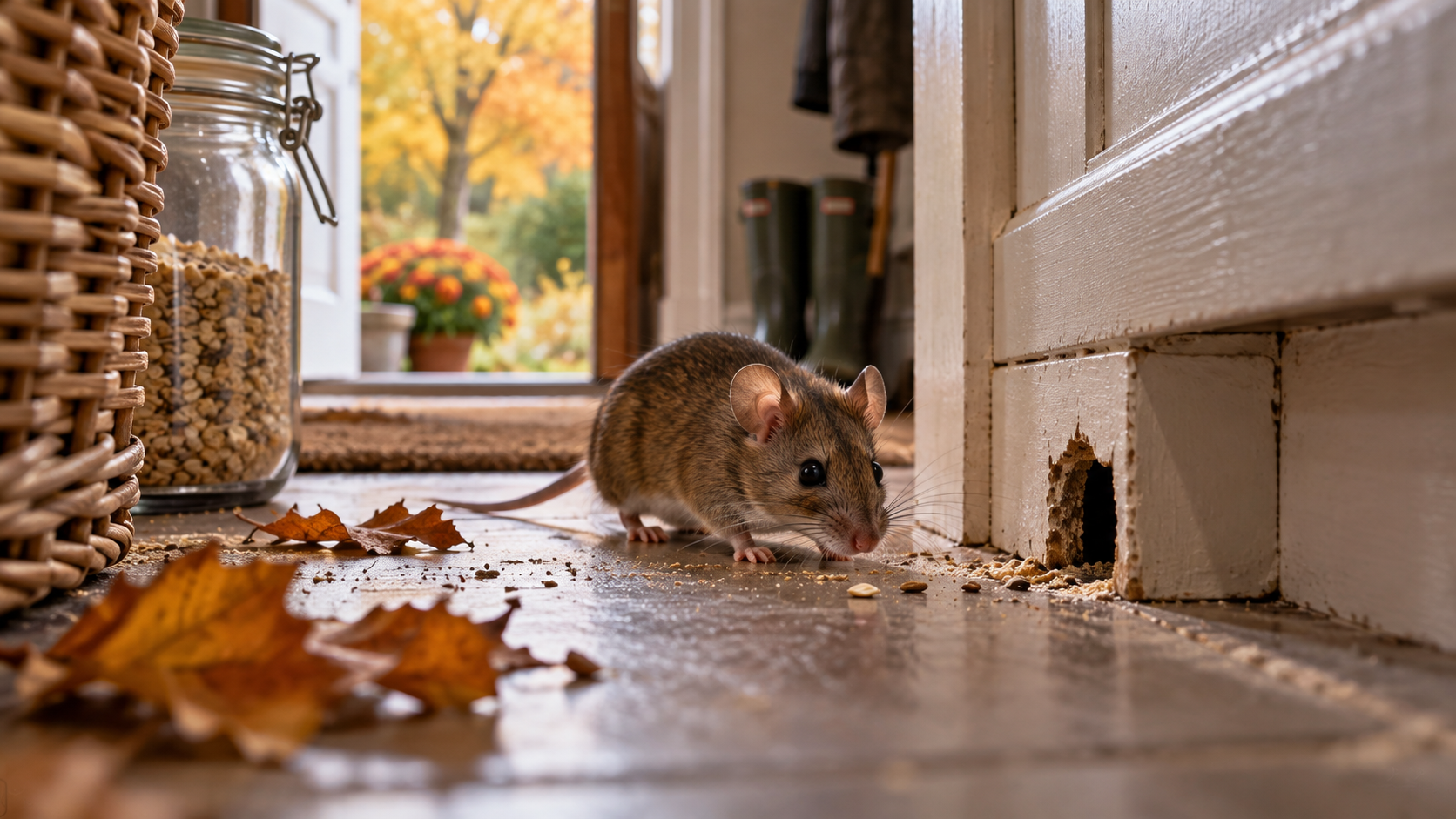
If you've heard scratching in the loft or found small droppings in a cupboard, you're not alone. Mice move indoors every autumn, and this year pest controllers across the UK are reporting one of the biggest surges in years.
As the weather cools, mice look for somewhere warm, dry and close to food. Your home ticks every box. Once they're in, they breed fast and can be hard to shift without the right approach.
Below, we'll cover why mice come indoors in autumn, the warning signs to look for, what to do if you already have them, and how to stop them coming back.
Need help right now? Call us on 0208 066 0360 — we offer 24/7 emergency response for pest infestations.
Why do mice move indoors in autumn?
Mice don't hibernate, so once it gets cold outside, they need to find shelter fast.
Your home offers everything they need:
- Warmth, especially near boilers, ovens and heating pipes
- Food, from crumbs and bins to pet food and stored dry goods
- Safe, quiet spaces to nest and breed, like lofts, wall cavities and under floors
This year, a mild and wet autumn has made the problem worse. Pest controllers are reporting rat and mice activity up nationally, with some regions seeing rises of 50%. Mice are moving in earlier than usual and breeding for longer before winter fully sets in.
Why mice are a problem (and what happens when they're not dealt with)
A couple of mice in your loft can turn into a much bigger problem within weeks. Female mice can have up to 10 litters a year, with 6 to 8 pups each time.
Left untreated, mice can cause:
- Gnawed wiring, which is a genuine fire risk
- Damaged insulation, pipework and woodwork
- Contaminated food and work surfaces through droppings and urine
- Unpleasant smells from nesting areas and waste
- Health risks, including salmonella and other bacteria spread through droppings
The longer an infestation runs, the more damage it does and the harder it is to clear.
Common ways mice get into UK homes
Mice can squeeze through a gap the size of a pencil, so it's easier than you'd think for them to get in. The usual entry points are:
- Gaps around pipes, cables and air bricks
- Loose brickwork, damaged render or gaps under doors
- Roof edges, soffits and loft vents
- Gaps around windows and utility rooms
- Shared walls and cavities, especially in terraced or semi-detached homes
If you live near farmland or open fields, mice may also push indoors earlier than average as those areas cool down first.
Signs you have mice in your home
If you spot any of the below, it's usually time to act:
- Small, dark droppings (around the size of a grain of rice), often near food or skirting boards
- Scratching or scurrying sounds, especially at night
- Gnaw marks on wood, wiring, cables or food packaging
- A stale, musky smell in enclosed spaces like cupboards or lofts
- Nesting material, like shredded paper, fabric or insulation, tucked into quiet corners
- Grease marks or smudges along skirting boards and walls, where mice repeatedly brush past
Tip: don't wait until you've seen a mouse to take it seriously. By the time you spot one, there are usually more nearby that you haven't.
What to do if you already have mice
If you think you have mice in your home, act quickly to stop the problem growing.
- Find and remove food sources — store dry food in sealed containers and clear crumbs, spills and pet food promptly
- Don't rely on DIY traps alone — shop-bought traps can catch the odd mouse but rarely clear a full infestation, especially once they've started breeding
- Avoid sealing entry points too early — closing gaps before mice are fully removed can trap them inside your walls
- Call pest control professionals — we'll identify how they're getting in, treat the infestation safely, and confirm it's fully cleared
- Arrange a deep clean if needed — droppings and nesting material should be cleaned and disinfected properly, not just swept away
At ICE Cleaning, we can treat an active infestation and carry out any decontamination cleaning needed afterwards, so your home is genuinely mouse-free, not just quieter for a few weeks.
How to stop mice coming back this winter
Getting rid of mice is only half the job. Keeping them out matters just as much.
Seal up entry points Fill gaps around pipes and cables with wire wool before sealing over with filler, since mice can't gnaw through it. Fit mesh over air bricks and vents.
Keep food out of reach Store dry food, pet food and bird feed in sealed containers, and keep bins tightly shut.
Reduce clutter in lofts and sheds Mice nest in undisturbed, cluttered spaces. Clearing lofts, garages and sheds removes easy nesting spots.
Check your property before the cold really sets in Late September and early October, before temperatures drop consistently, is the best time to check for gaps and deal with any early activity.
Consider a professional inspection If you've had mice before, or live somewhere prone to them, a proper inspection can catch problems before they take hold. Our rodent control service covers inspection, treatment and prevention advice tailored to your property.
Contact us today
ICE Cleaning provides rodent control and pest management for homes and businesses across the UK, with 24/7 emergency response when you need it fast.
To book a survey or request urgent support, contact our team on 0208 066 0360 or contactus@icecleaning.co.uk

Speak with me today,
I’m here to help
By asking you a few questions either via phone or email I can immediately provide a realistic estimation of the cost.

Why choose us?
- Cater to a wide variety of cleaning situations
- Nationwide coverage, available 24/7
- Cater to commercial and domestic clients
- Free survey provided prior to quotation
- Emergency response team
- Offer a bespoke service designed to suit all your needs
- All technicians hold professional health and safety qualifications, including BICSc, IOSH, Dewpoint Professional & Safe Contractor
We’re fully accredited
We place best practise, professional expertise and health and safety at the core of our business. We’re fully compliant with all legal obligations. You can view a list of our accreditations below, or visit our Health & Safety page for more information.