What Is TR19? Kitchen Extract Cleaning Rules for Commercial Kitchens
If you run a commercial kitchen, your insurer may have asked for a TR19 certificate. Or your landlord. Or a fire officer. And if you've never heard of it, that's a worrying email to get.
Here's what TR19 is, what it asks of you and how to stay on the right side of it.
What is TR19?
TR19 is a technical specification for cleaning ventilation systems, written by BESA, the Building Engineering Services Association. The part that matters for kitchens is called TR19 Grease. It sets out how kitchen extract systems should be cleaned, how often, and how that cleaning should be checked and recorded.
It isn't a law on its own. But it's the standard insurers, fire safety officers and landlords use to judge whether you're looking after your extract system. In practice, it's the benchmark.
Why it matters
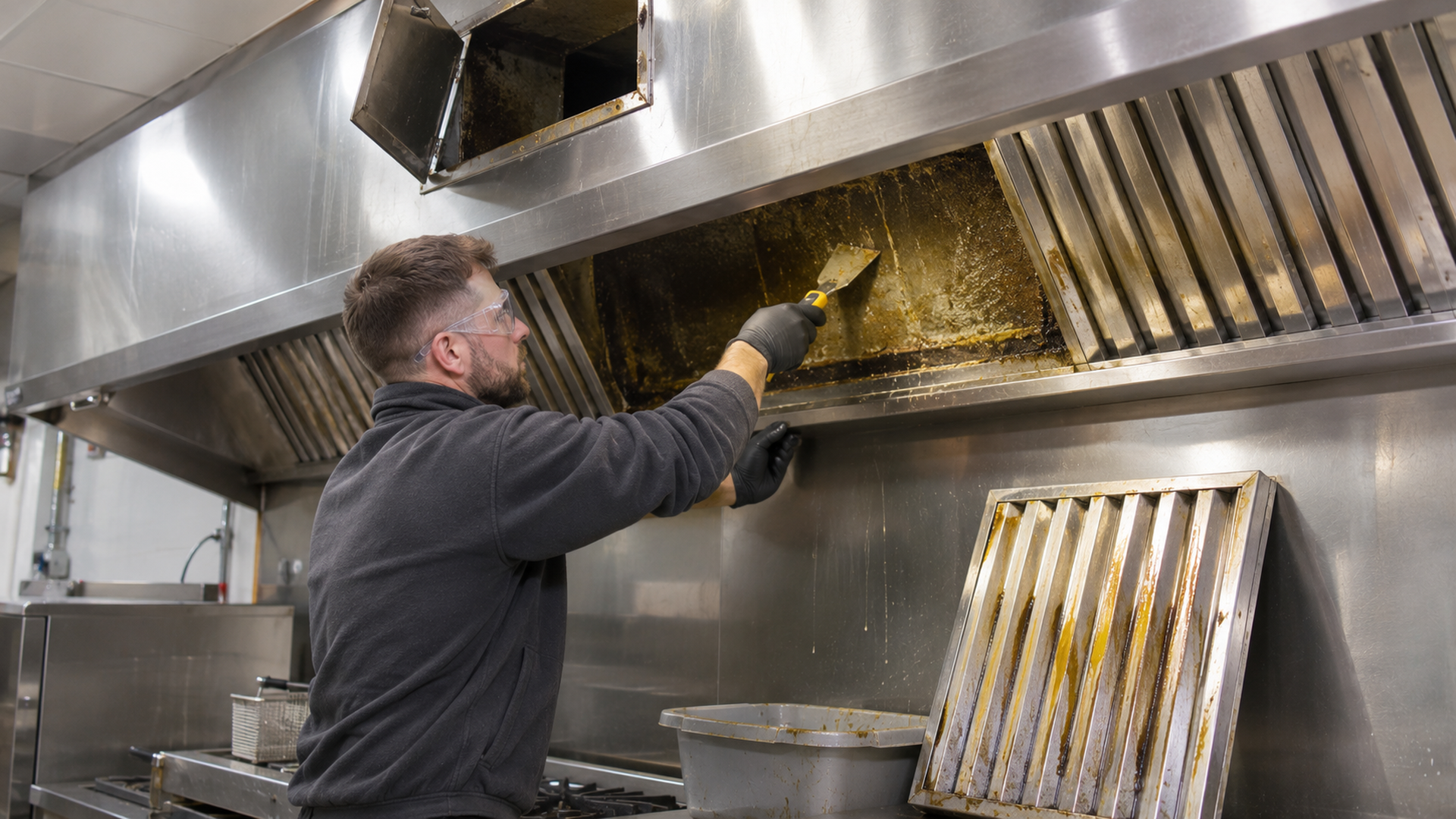
Every time you cook, grease rises into the canopy and gets pulled through the filters and into the ductwork. Over time it builds up on the inside of the ducts.
That grease is a fire risk. If a fire starts on the cooker, flames can get into the ducts and travel through the building. BESA quotes London Fire Brigade figures of a kitchen extract fire roughly every nine days in Greater London.
Insurers know this. Many now ask for proof of regular cleaning. If a fire is traced back to a dirty extract system, your claim could be refused.
How often should kitchen extracts be cleaned?
TR19 Grease bases the minimum cleaning frequency on how many hours a day the kitchen is in use:
|
Daily use |
Minimum cleaning frequency |
|---|---|
|
Heavy (12 to 16 hours a day) |
Every 3 months |
|
Moderate (6 to 12 hours a day) |
Every 6 months |
|
Light (2 to 6 hours a day) |
Every 12 months |
These are minimums. Kitchens that fry a lot, cook with charcoal or run very long hours may need cleaning more often.
What is the 200 micron rule?
TR19 Grease says the grease inside the ducts should not build up past an average of 200 microns between cleans. That's about half the thickness of a business card.
Any area with 500 microns or more needs cleaning straight away.
Grease thickness is measured with a test at points along the ductwork. It's a good way to check whether your cleaning schedule is often enough.
What should a TR19 report include?
A clean isn't finished until it's recorded. A proper post-clean report should include:
- Before and after photos from the same positions
- Grease thickness test results
- A summary of what was cleaned
- Any areas that couldn't be reached, and why
- Recommendations, such as adding access panels
- A certificate with the date, location and technician's name
Keep these reports with your fire safety records. They're what your insurer will ask for.
The parts that often get missed
A quick clean of the canopy and filters isn't a full extract clean. The whole system includes:
- The canopy and grease filters
- The ductwork, including bends and long horizontal runs
- The extract fan
- The point where air leaves the building
The hidden ductwork is where most of the grease sits and where fires spread. If there aren't enough access panels to reach it, your report should say so.
Simple habits that help between cleans
- Clean or swap the grease filters often. Daily in busy kitchens.
- Wipe down the canopy as part of your closing routine.
- Don't run the cooker without the extract on.
- Report any drips of grease from the canopy or ducts.
- Keep a record of every clean.
See our guide on how often a commercial kitchen should be deep cleaned and the most common fire hazards in kitchens.
How ICE Cleaning can help
Our kitchen ventilation cleaning and duct cleaning teams clean the whole extract system, not just the parts you can see. We can work out of hours so your kitchen keeps trading, and we can combine it with a full commercial kitchen deep clean.
Our technicians hold BICSc, IOSH, IPAF and SafeContractor qualifications.
Book your extract clean
Not sure when your system was last cleaned properly? Call 0203 826 8135 or email contactus@icecleaning.co.uk. We start with a free, no-obligation site survey.
Related reading: how to clean kitchen exhaust ducts.

Why choose us?
- Cater to a wide variety of cleaning situations
- Nationwide coverage, available 24/7
- Cater to commercial and domestic clients
- Free survey provided prior to quotation
- Emergency response team
- Offer a bespoke service designed to suit all your needs
- All technicians hold professional health and safety qualifications, including BICSc, IOSH, Dewpoint Professional & Safe Contractor
We’re fully accredited
We place best practise, professional expertise and health and safety at the core of our business. We’re fully compliant with all legal obligations. You can view a list of our accreditations below, or visit our Health & Safety page for more information.