Awaab's Law for Private Landlords: What the 2026 Consultation Means for Damp and Mould
If you rent out a home, you've probably heard of Awaab's Law. Until now it has only applied to social housing. That's about to change.
On 9 October 2026 the government opened a consultation on bringing Awaab's Law into the private rented sector. It closes on 18 December 2026. Nothing has changed for private landlords yet, but the direction is clear. Damp and mould will come with fixed deadlines.
Here's what's being proposed, what it could mean for you and what you can do now so you're not caught short.
This guide covers England. It isn't legal advice, so check the final rules once they're published.
What is Awaab's Law?
Awaab's Law is named after Awaab Ishak, a two-year-old who died in 2020 after long exposure to mould in his family's social housing flat in Rochdale. The law sets strict deadlines for landlords to investigate and fix serious hazards, starting with damp and mould.
For social landlords it has been in force since 27 October 2025. Read our earlier guide to what Awaab's Law is.
Where things stand for social housing
Social housing is moving in stages:
- Phase 1 (since 27 October 2025): damp and mould, plus all emergency hazards.
- Phase 2 (due 30 November 2026, subject to Parliament): adds hazards such as fire, electrical, cold, heat, falls, structural problems and hygiene.
- Phase 3 (due in 2027): the remaining hazards.
Under the social housing rules, a landlord must:
- Investigate a significant hazard within 10 working days
- Give the tenant a written summary within 3 working days of the investigation
- Make the home safe within 5 working days where there's a significant risk
- Deal with emergency hazards within 24 hours
What the private rented consultation proposes
The Renters' Rights Act 2025 gives the government the power to extend Awaab's Law to private rentals. The consultation asks how that should work.
The proposed timescales are offered as options. The middle option in each case matches the social housing rules:
|
Step |
Options being consulted on |
|---|---|
|
Investigate a possible significant hazard |
5, 10 or 15 working days |
|
Send the tenant a written summary |
1, 3 or 5 working days |
|
Make a significant hazard safe |
3, 5 or 10 working days |
|
Start further work to stop it coming back |
3, 5 or 10 working days |
|
Deal with an emergency hazard |
12, 24 or 48 hours |
When will it start?
Not yet. The consultation gives 2027 as the earliest possible start. The government's impact assessment assumes it will be phased in between 2028 and 2030.
So there's time. But damp and mould don't wait for legislation. And the law is already tough on landlords who ignore it. Read can landlords be fined for ignoring mould.
What it will mean in practice
Once it applies, a damp or mould report from a tenant will start a clock. You'll need to:
- Respond quickly. Get someone to look at it within the deadline.
- Find the cause. Is it condensation, a leak, rising damp or a building fault? The fix depends on the cause.
- Tell the tenant in writing. What you found, what you'll do and when.
- Make it safe fast. Remove the mould and stop the immediate risk.
- Fix the cause. Ventilation, leaks, insulation or repairs.
- Keep records. Dates, photos, reports and invoices.
The hardest part for most landlords won't be the work. It will be proving what was done and when.
How to get ahead now
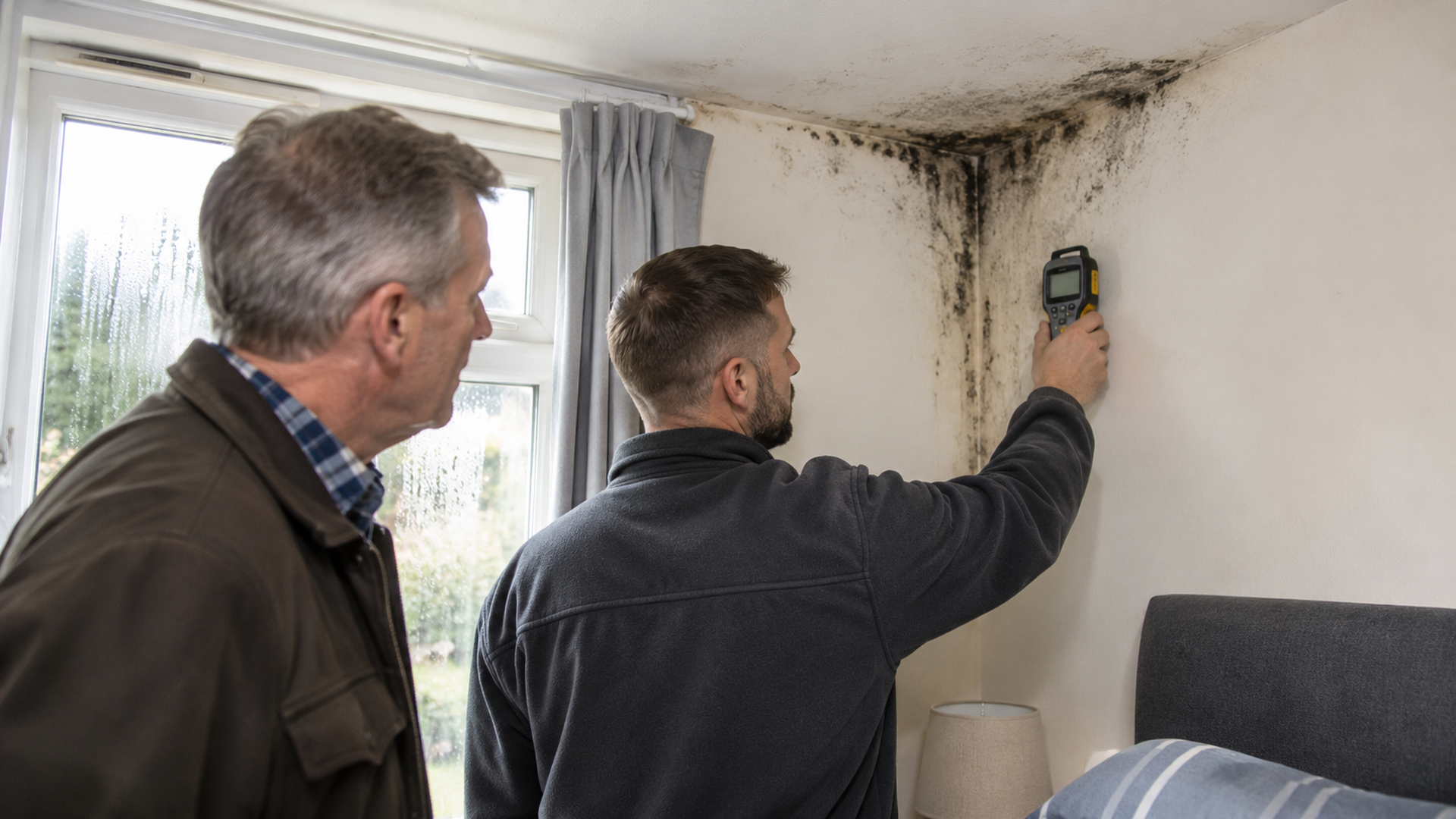
Check your properties before winter. Damp and mould get worse when windows are shut and the heating is on. Look at bathrooms, bedroom corners, behind wardrobes and around windows.
Set up a simple reporting route. Give tenants one email address or phone number for damp and mould. Log every report with the date.
Get a proper survey when mould keeps coming back. Wiping it off doesn't fix it. A damp and moisture survey finds the cause. Read more about what a damp survey involves.
Treat the mould properly. Bleach and a cloth rarely last. Professional mould remediation removes it and treats the surfaces so it's less likely to return.
Keep the paperwork. Survey reports, photos and invoices show you acted. They'll matter even more once the deadlines apply.
Who is responsible for mould in a rented home?
Usually the landlord, where the cause is the building: leaks, poor ventilation, a broken extractor fan or rising damp. Tenants have a part to play too, such as using extractor fans and not blocking vents. But the landlord can't simply blame lifestyle without checking the cause first. Our guide on who is responsible for mould in a rental property goes into more detail.
How ICE Cleaning helps landlords
We work with private landlords, letting agents and housing providers. We can:
- Survey the property and find the cause of the damp
- Remove mould safely and treat the affected areas
- Give you a written report with photos for your records
- Advise on what will stop it coming back
See our Awaab's Law support for landlords. Every job starts with a free, no-obligation site survey, and our technicians hold BICSc, IOSH, IPAF and SafeContractor qualifications.
Get a damp and mould check
Don't wait for the law to catch up. Call 0203 826 8135 or email contactus@icecleaning.co.uk

Why choose us?
- Cater to a wide variety of cleaning situations
- Nationwide coverage, available 24/7
- Cater to commercial and domestic clients
- Free survey provided prior to quotation
- Emergency response team
- Offer a bespoke service designed to suit all your needs
- All technicians hold professional health and safety qualifications, including BICSc, IOSH, Dewpoint Professional & Safe Contractor
We’re fully accredited
We place best practise, professional expertise and health and safety at the core of our business. We’re fully compliant with all legal obligations. You can view a list of our accreditations below, or visit our Health & Safety page for more information.